Outdoors, sorted: the trails, the falls, and the parks
Every verified trail, waterfall, and park in and around Rancho Cucamonga, sorted by how hard it is and what month it is — with the permit, dog, and closure rules up front.
The city sits against the San Gabriels, and the mountains do most of the work. Etiwanda Falls is a real waterfall about forty minutes' walk from a suburban trailhead, Icehouse Canyon puts you at 7,600 feet before lunch, and the Pacific Electric Trail gives you twenty flat miles on the old Red Car line for free. Add a city that budgets for parks the way some cities budget for stadiums and you have a lot of outdoor days to choose from.
This guide covers the eight outdoor places we've verified, sorted two ways: by how much effort they ask of you, and by what month it is. The second sort matters more here than in most cities. The falls run on a schedule, the wind has opinions, and one trailhead lot is full before most people have had coffee. Get the logistics right and the trails take care of themselves.
Before you drive anywhere
Three things decide whether an outdoor day here works.
- The falls are seasonal. Etiwanda Falls runs strongest December through April. In high summer, and in drought years, it slows to a trickle or stops. A waterfall hike in August is a hike, not a waterfall.
- Closures come with little notice. The North Etiwanda Preserve closes ad hoc during fire and wind events, and in fall that happens with little warning. Check the preserve and forest alert pages the morning you go, not the night before.
- The preserve's rules are enforced. No dogs. Parking requires a permit bought online in advance, $4 for a half day or $7 for a full day. Gates lock at sunset and cars are towed.
Sorted by effort
Easy: a loop, a lake, some horses
Red Hill Community Park is the best all-purpose park day in the city: 48 acres on the Red Hill slope with a half-acre lake full of ducks and turtles, pickleball courts, an amphitheater, and an exercise loop that runs about a mile. Hours are 6am to 10pm daily and it costs nothing. The South Beautification Project has parts of the park fenced and some paths rerouted until it wraps, so expect a detour or two.
Heritage Community Park in Alta Loma is the character pick. Its 41 acres hold a working equestrian center, so the entertainment is standing at the arena fence watching horses being worked while the kids do the playground circuit. Alta Loma kept its horse trails along the streets when the valley below paved over, and this park is where that culture shows up. The 0.7-mile park trail connects to the Cucamonga Creek Trail, which makes the walk as long as you want it. Free, dog-friendly, open daylight hours.
Central Park is the civic backyard: 100 acres on Base Line Road with long lawns, a free outdoor fitness court, a Veterans Memorial, and the community and senior centers. For dog owners the headline is The Bark, 4.4 acres of dog park split into three separate enclosures, opened in late 2023 and running dawn to dusk. Parking is free and plentiful.
Route 66 Trailhead Park is here as a door, not a destination. It's a pocket park on the historic Foothill Boulevard alignment whose real job is getting you onto the Pacific Electric Trail from the west side of the city, with free parking, dogs welcome, and Route 66 theming to look at while you lace up. For a lake-and-lawn afternoon, Red Hill is close by and far larger.
Moderate: the falls and the rail-trail
Etiwanda Falls at the North Etiwanda Preserve is the hike everyone in the city does, and in the right month it deserves the traffic: about 3.6 miles round trip with 700-plus feet of gain up an old utility road, the valley floor spread out behind you the whole way. The trailhead sits at the top of Etiwanda Avenue. The weekend lot fills by about 7am, so dawn is the plan. The rules in the section above apply every day of the year; the full briefing has the rest.
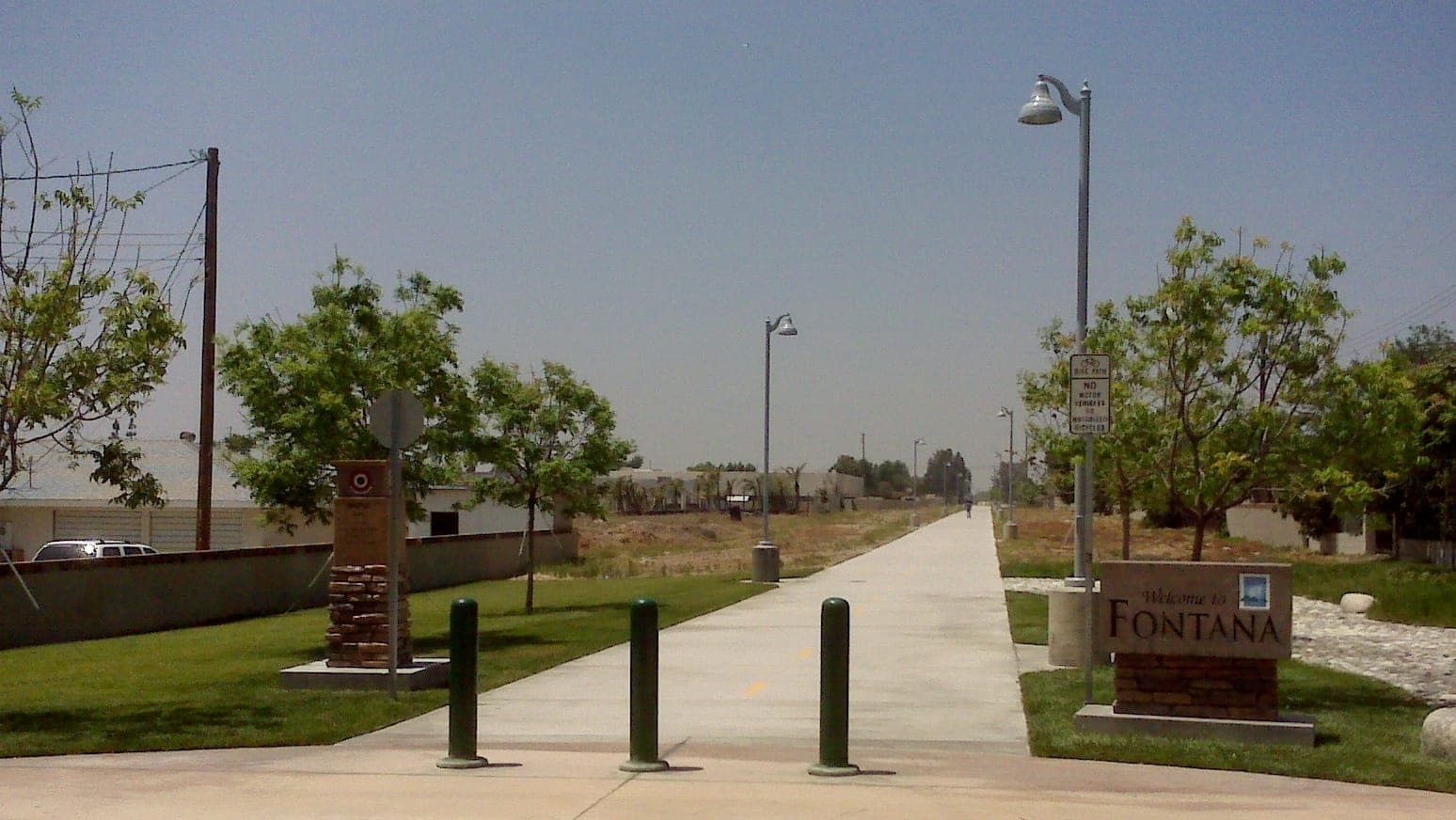
The Pacific Electric Trail is flat, so calling it moderate is about distance, not grade. The old Red Car right-of-way is now a 20-mile paved trail from Claremont to Rialto, and about six of those miles cross Rancho Cucamonga. Cyclists get an east-west spine with signaled street crossings most of the way, runners and walkers get a parallel crushed-stone path for most of the city stretch, and equestrians still use it near Alta Loma. Mountain views ride along the whole way when the air is clear. Park at the Kenyon Way trailhead. Ride west and you can be in Claremont Village for coffee in under an hour; ride east and it's quiet suburbia and open sky. No fees, no permits, no gates, and it's the walk to take on the day the preserve closes for wind.
Hard: the graduation hike
Icehouse Canyon, up in Mt Baldy, is what locals move on to once the falls stop being interesting: 7.2 miles round trip and about 2,600 feet of climbing to Icehouse Saddle at 7,632 feet, with actual conifers and cooler air. The wilderness permit is free and self-serve from the box at the trailhead; take the minute and fill it out. The lot is tiny and fills first thing, so dawn again. This is San Gabriel Mountains hiking with San Gabriel Mountains consequences, meaning weather, altitude, and no services. Carry more water than the city trails have taught you to.
Sorted by season
December through April: waterfall season
This is when the falls run, and it's the window to plan around. Go at dawn, ideally in February, with the permit already bought, and it's the best outdoor hour the city has. Both the perfect day and the weekend itineraries start here at 7am for exactly that reason.
Summer: water where you can find it
Expect the falls to be a trickle, and go early or go up. The Pacific Electric Trail is unlit along most stretches, so a morning start beats an evening one. Icehouse Canyon's elevation buys cooler air, but the lot rule still applies.
Two parks earn their keep in summer. Red Hill runs free movie nights on Fridays in season; check the city's calendar for the current lineup. Cucamonga-Guasti Regional Park, just over the Ontario line, has 150 acres, two fishing lakes, a playground, and a splash pad that does brisk business. Read the fine print before you promise anyone a swim: the swim lagoon is closed until further notice and the lakes carry an algae "Caution" advisory, so keep kids and dogs out of the lake water. Entry is per vehicle, $10 weekdays, $15 weekends, $20 holidays, or $3 if you walk in, plus $1 per dog. Hours are 7:30am to 8pm daily.
Fall: wind season
Fall is when fire and wind closures happen with little notice. Etiwanda sits at the mouth of the Cajon Pass weather, and the eucalyptus windrows there and in Alta Loma were planted a century ago against the Santa Anas for a reason. When the preserve closes, the Pacific Electric Trail and the parks are the plan. Check the alert pages the morning of, every time.
The quick sort
- Bringing a dog: The Bark at Central Park, the Pacific Electric Trail, Heritage, Red Hill, Route 66 Trailhead Park, and Cucamonga-Guasti for a dollar. Not the preserve.
- Bringing small kids: the lake at Red Hill, the horses at Heritage, the lawns at Central Park, the splash pad at Guasti.
- Bringing a bike: the Pacific Electric Trail, which is flat enough for beginners and kids, and RC Rides, the free monthly community ride that leaves Central Park at 8am on the third Saturday.
- Bringing nothing: the city parks and the Pacific Electric Trail are free, and Etiwanda Falls is a free hike with a paid parking lot. The free things hub has the rest of the zero-dollar list.
What this guide leaves out
We don't send anyone to Cucamonga Canyon. Its legal access status is unresolved and the fines were real, so until that changes it stays off our lists no matter how good the photos look. We also only cover places we've verified, which is why this is eight entries and not thirty. Every listing linked above shows its verification date; when something changes, the listing changes first.
For the ranked versions of all this, see the best hikes and the best parks. For the neighborhoods these places sit in, Etiwanda, Alta Loma, and Red Hill each have a page. And if you're new in town and want the short version, start with the five-stop orientation.